in
Book Club: Soccer In Sun And Shadow
Published on: February 26, 2026
By Drew
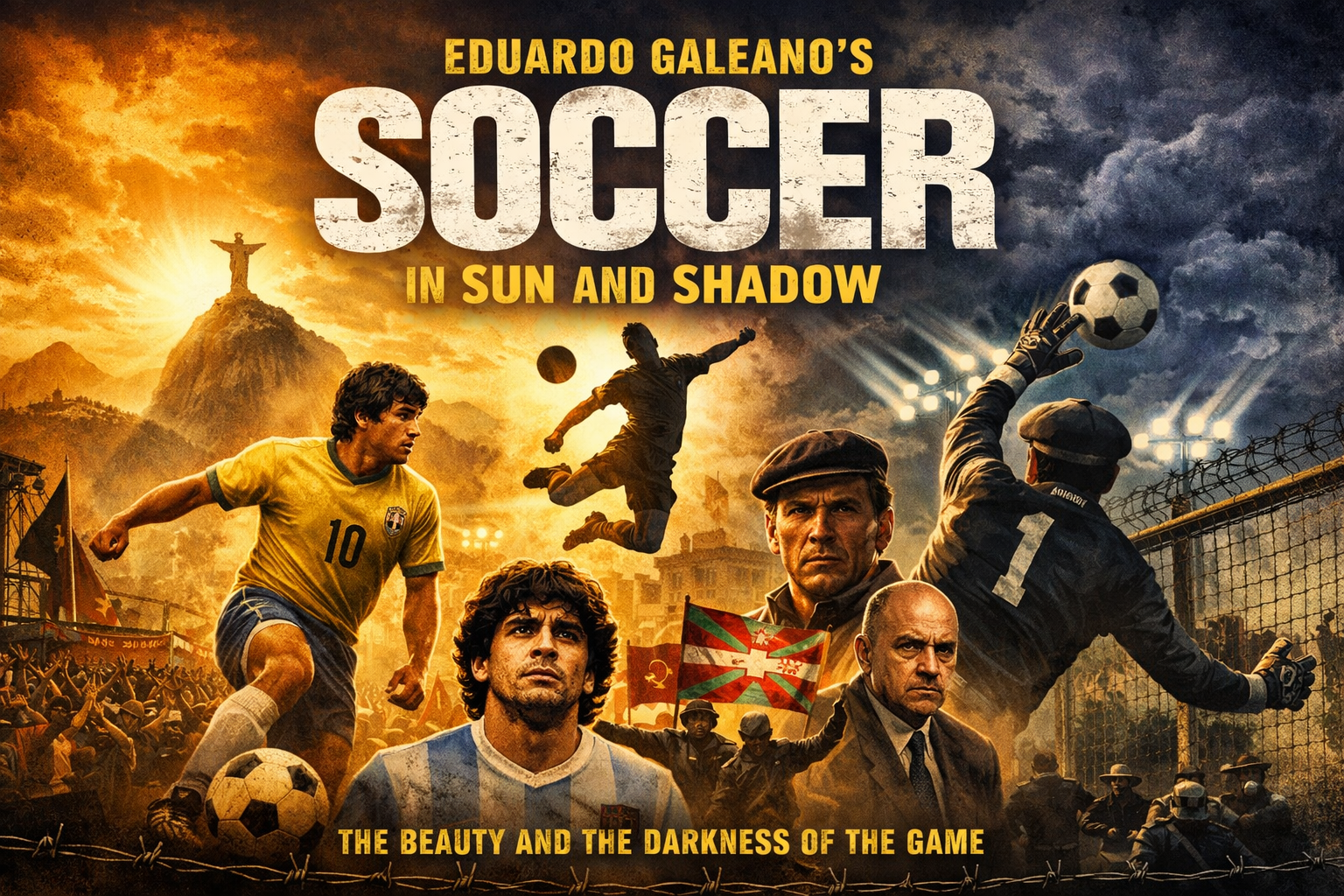
Playing in the Sun, Living in the Shadow:
A Thematic Analysis of Eduardo Galeano’s Soccer in Sun and Shadow
In Soccer in Sun and Shadow, Eduardo Galeano presents soccer not merely as a sport but as a cultural text through which modern society can be read. Through brief poetic fragments rather than linear narrative, Galeano constructs a dialectical vision of the game: soccer as art and commodity, liberation and imprisonment, communal ritual and corporate spectacle.
Galeano argues that soccer is a microcosm of modern society in which beauty and imagination persist despite the encroaching forces of commodification, political repression, and bureaucratic efficiency; through style and play, communities assert identity and resist the homogenizing machinery of power.
Soccer as Sacred Desire and Aesthetic Expression
Galeano begins with confession: “Years have gone by and I finally learned to accept myself for who I am, a beggar for good soccer. I go about the world, hand outstretched, and in the stadiums I plead, a pretty move, for the love of God” (1). The metaphor of begging reframes the spectator not as consumer but as supplicant. Beauty is scarce, sacred, and unpredictable.
The ball itself is personified and feminized: “She can’t stand getting kicked around or hit out of spite. She insists on being caressed, kissed, lulled to sleep on the chest or the foot” (21). Soccer’s highest form is not force but tenderness. On page six, the virtuoso player animates the ball: “The ball seeks him out, knows him, meets him. She rests on the top of his boot. He caresses her and makes her speak, and in that, three million mutes converse” (6). The act of play becomes speech for the voiceless.
The goal, Galeano writes, “is soccer’s orgasm, and like orgasm, goals have become an ever-less frequent occurrence in modern life” (9). Ecstasy is increasingly rare in a world governed by defensive tactics and calculated restraint. Pleasure, in both sport and society, is rationed.
The Machinery of Spectacle and Commodification
Against the sacred dimension of play stands what Galeano calls “the machinery of spectacle” (12). The successful player becomes imprisoned by his own achievement: “The more successful he is, the more money he makes, the more of a prisoner he becomes. Forced to live by military discipline, he suffers the punishing daily round of training and the bombardments of painkillers and cortisone” (3). The athlete’s body is commodified, regulated, and chemically managed.
Managers are equally disposable: “The machinery of spectacle grinds up everything in its path. Nothing lasts very long, and the manager is as disposable as any other product of consumer society” (12). Soccer mirrors capitalist production cycles; individuals are valued only as long as they perform.
Galeano makes this explicit in his discussion of the 1986 World Cup: “Who ran the ’86 World Cup? The Mexican Soccer Federation? No, please. No more intermediaries. It was run by Guillermo Cañedo, vice president of Televisa” (169). Here Galeano identifies Televisa as emblematic of corporate control over global soccer. The spectacle is owned, broadcast, and monetized.
Modern tactics further reflect bureaucratic caution: “The highly praised efficiency of mediocrity. In modern soccer there are ever more teams made up of functionaries specialized in avoiding defeat rather than players who run the risk of acting on inspiration” (171). Avoidance replaces imagination; risk becomes liability.
Collective Identity and the Stadium as Ritual Space
Despite commercialization, soccer retains its communal power. “Rarely does the fan say, ‘My club plays today.’ Rather, he says, ‘We play today’” (7). Identity dissolves into collective belonging.
The stadium itself carries memory: “Have you ever entered an empty stadium? Try it. Stand in the middle of the field and listen. There is nothing less empty than an empty stadium” (19). The space holds echoes of collective emotion. It is a secular cathedral.
Yet communal fervor borders on madness. “The fanatic is a fan in a madhouse” (8). The goalkeeper, wearing “the number one on his back,” is “the first to pay” (4). The referee is scapegoat: “The losers owe their loss to him and the winners’ triumph in spite of him” (11). Collective identity requires figures upon whom blame can be projected.
Politics on the Pitch
Soccer also becomes political theater. During the Spanish Civil War, FC Barcelona symbolized “democracy under siege,” and under Francisco Franco, stadiums such as Camp Nou and San Mamés Stadium became sanctuaries for suppressed Catalan and Basque identity (36).
Similarly, Galeano recounts that the club Argentinos Juniors was born as Chicago Martyrs, honoring anarchist workers (34). Soccer grounds become stages where political memory survives.
On an international scale, Ruud Gullit dedicated his European award to Nelson Mandela, who had “spent many years in jail for the crime of believing that blacks are human” (178). Soccer intersects with anti-apartheid struggle and global justice movements.
Poverty, Race, and Improvisation
Galeano does not romanticize inequality. “They all have the same rights, but the players who grew up hungry and the athlete who never missed a meal don’t really compete on a level playing field” (43). Yet poverty generates improvisational brilliance. “Misery trains him for soccer or for crime” (44). The dribble becomes survival strategy.
Brazilian style, free of “right angles,” mirrors the curves of Rio and the architecture of Oscar Niemeyer (42). Style becomes geography, history, and resistance embodied.
Genius and Tragedy
Galeano mythologizes players while acknowledging their fragility. Of Garrincha he writes, “In the entire history of soccer, no one made more people happy” (104). Of Diego Armando Maradona: “He played better than anyone else in spite of the cocaine, not because of it” (199). Genius exists within contradiction.
Heroes dazzle yet remain trapped by fame, expectation, and the spectacle they animate.
Style as Ontology
Galeano’s culminating insight is philosophical: “I play, therefore I am” (209). He continues, “A style of play is a way of being that reveals the unique profile of each community… Tell me how you play and I’ll tell you who you are” (209). Soccer becomes anthropology. Formations reveal fear or courage, submission or creativity.
Conclusion
In Soccer in Sun and Shadow, Galeano constructs a dialectic between beauty and commodification, creativity and control. Soccer persists as a fragile but powerful site of resistance. Even under the machinery of spectacle, the ball still demands to be caressed; fans still say “we”; communities still affirm identity through play.
Soccer, in Galeano’s vision, is not escape from history but one of its most revealing stages.
Works Cited
Galeano, Eduardo. Soccer in Sun and Shadow. Translated by Mark Fried, Nation Books, 1997.
Quotes
Page 1
“Years have gone by and I finally learned to accept myself for who I am, a beggar for good soccer. I go about the world, hand outstretched, and in the stadiums I plead, a pretty move, for the love of God.”
Page 3
“The more successful he is, the more money he makes, the more of a prisoner he becomes. Forced to live by military discipline, he suffers the punishing daily round of training and the bombardments of painkillers and cortisone to forget his aches and fool his body.”
Page 4
“He wears the number one on his back, the first to be paid? No, the first to pay. And it’s always the keeper’s fault, and if it isn’t, he still gets blamed.”
Page 6
“The ball seeks him out, knows him, meets him. She rests on the top of his boot. He caresses her and makes her speak, and in that, three million mutes converse. The nobodies, those condemned to always be nobodies, feel they are somebodies for a moment by virtue of those one-two passes, those dribbles that draw Zs on the grass, those incredible back-heel goals or overhead volleys. When he plays, the team has twelve players, twelve, it has fifteen, twenty.”
Page 7
“Rarely does the fan say, ‘My club plays today.’ Rather, he says, ‘We play today.’ He knows it’s player number 12 who stirs up the winds of fervor that propel the ball when she falls asleep, just as the other 11 players know that playing without their fans is like dancing without music.”
Page 8
“The fanatic is a fan in a madhouse, his mania for denying all evidence finally upends whatever once passed for his mind, and the remains of the shipwreck spin about aimlessly in waters whipped by a fury that gives no quarter.”
Page 9
“The goal is soccer’s orgasm, and like orgasm, goals have become an ever-less frequent occurrence in modern life.”
Page 11
“The losers owe their loss to him and the winners’ triumph in spite of him, scapegoat for every error, cause of every misfortune. The fans would have to invent him if he didn’t already exist. The more they hate him, the more they need him.”
Page 12
“The machinery of spectacle grinds up everything in its path. Nothing lasts very long, and the manager is as disposable as any other product of consumer society. Today the crowd screams, ‘Never die!’ and the next Sunday they invite him to kill himself.”
Page 14
“Hours go by, years go by, until the referee orders them to take the corpse off the field. Suddenly he jumps, the player, whoosh, and the miracle of resurrection occurs.”
Page 16
“The organic potential of the game plan pursued by this struggling team has not been crowned with success, simply and plainly because the team continues to be incapable of adequately channeling its expectations for greater offensive projection in the direction of the enemy goal.”
Page 19
“Have you ever entered an empty stadium? Try it. Stand in the middle of the field and listen. There is nothing less empty than an empty stadium. There is nothing less mute than the stands bereft of people.”
Page 21
“She can’t stand getting kicked around or hit out of spite. She insists on being caressed, kissed, lulled to sleep on the chest or the foot. She’s proud, vain, perhaps, and she’s not lacking motive. She knows all too well that when she rises gracefully, she brings joy to many hearts, and many a heart is crushed when she lands without style.”
Page 22
“In soccer, as in almost everything else, the Chinese were first. Five thousand years ago, Chinese jugglers had balls dancing on their feet, and it wasn’t long before they organized the first games.”
Page 29
“Meanwhile, other English words were being incorporated into the speech of Latin American countries in the Caribbean. Pitcher, catcher, innings have fallen under the U.S. influence. These countries learned to hit a ball with the rounded wooden bat. The Marines shouldered bats next to their rifles when they imposed imperial order on the region by blood and fire. Baseball became for the people of the Caribbean what soccer is for us.”
Page 31
“Soccer players created their own language in that tiny space where they chose to retain and possess the ball rather than kick it, as if their feet were hands braiding the leather. On the feet of the first Creole virtuoso El Torque, the touch was born. The ball was strummed as if it were a guitar, a source of music.”
Page 32
“From then on, father and son, rebellious son, abandoned father, dedicated their lives to hating each other. Each Fla-Flu classic is a new battle in a war without end. The two love the same city, lazy, sinful Rio de Janeiro, a city that languidly lets herself be loved, toying with both and surrendering to neither.”
Page 34
“The club Argentinos Junior was born with the name Chicago Martyrs in homage to those anarchist workers and May 1st was the day chosen to launch the club. In Buenos Aires’ anarchist library for those of the years of the century, plenty of left-leaning intellectuals celebrated soccer instead of repudiating it as a sedative of consciousness.”
Page 36
“It was 1937 and Barcelona’s president had already fallen under Franco’s bullets. On the soccer field and off, both teams embodied democracy under siege. Only four of Barcelona’s players made it back to Spain during the war. Of the Basques, only one. When the Republic was defeated, FIFA declared the exiled players to be in rebellion and threatened them with permanent suspension, but a few managed to find positions with Latin American teams. Several of the Basques formed the club España in Mexico, who was unbeatable in its early years.”
Page 42
“This was born a style open to fantasy, one which refers pleasure to results. From Friedenreich onward, there have been no right angles in Brazilian soccer, just as there are none in the mountains of Rio de Janeiro or the buildings of Oscar Niemeyer.”
Page 43
“They all have the same rights, but the players who grew up hungry and the athlete who never missed a meal don’t really compete on a level playing field. But at least soccer offers a shot at social mobility for a poor child, usually black or mulatto, who had no other toy but a ball.”
Page 44
“Misery trains him for soccer or for crime. From the moment of birth that child is forced to turn his disadvantage into a weapon, and before long he learns to dribble around the rules of order which deny him a place. He learns the tricks of every trade and becomes an expert in the art of pretending, surprising, breaking through where least expected, and throwing off an enemy with the hip fake or some other tune from the rascal’s songbook.”
Page 46
“The English squad had perfected the long pass and the high ball, but these disinherited children from far-off America didn’t walk in their father’s footsteps. They chose to invent a game of close passes directly to the foot, with lightning changes in rhythm and high-speed dribbling.”
Page 73
“A man of impenetrable style, he was always whistling and looking the other way. He scorned speed. He would play in slow motion, master of suspense, lover of leisure. The art of bringing the ball out of the box, slowly, calmly, was baptized dominguada. When he finally let the ball go, he did so without ever running and without wanting to, because it saddened him to be left without her.”
Page 83
“In soccer, as in everything else, consumers are far more numerous than producers. Asphalt covers the empty lots where people used to pick up a game, and work devours our leisure time. Most people don’t play; they just watch others play on television or from stands that lie even farther from the field. Like carnival, soccer has become a mass spectator sport, but just like the carnival spectators who start dancing in the streets, in soccer there are always a few admiring fans who kick the ball every so often out of sheer joy.”
Page 99 (Di Stéfano)
“He never stood still, holding his head high, he could see the entire playing field and cross it at a gallop to pry open the defense and launch the attack. He was there at the beginning, the during, and the end of every scoring play. He scored goals of all colors.”
Page 104 (Garrincha)
“There is no other right winger like him. In the 1958 World Cup, he was the best in his position, in ’62 the best player in the championship, but throughout his many years on the field, Garrincha was more. In the entire history of soccer, no one made more people happy.”
Franco Era Stadiums (page context following 104)
“During the dictatorship of Franco, two stadiums, Nou Camp in Barcelona and San Mamés in Bilbao, were sanctuaries for outlawed nationalist sentiment. There, Catalonians and Basques could shout and sing in their own language and wave their outlawed flags. The first time the Basque standard was raised without provoking a beating from the police was in a soccer stadium.”
Page 117 (Yashin)
“He liked to stop thundering blasts with his single claw-like hand that trapped and shredded any projectile. While his body remained motionless like a rock, he could deflect the ball with a glance.”
Page 122
“The ’66 World Cup was unspurred by defensive tactics. Every team used the sweeper system with an extra defender by the goal line behind the full-backs. Even so, Eusébio, Portugal’s African artilleryman, managed to pierce those impenetrable rearguard walls nine times.”
Page 137
“In the 1970 World Cup, Brazil played a soccer worthy of her people’s yearning for celebration and craving for beauty. All the world was suffering from the mediocrity of defensive soccer, which had the entire side hanging back to maintain the catenaccio, while one or two men played by themselves up front. Risk and creative spontaneity weren’t allowed. Brazil, however, was astonishing, a team on the attack playing with four strikers: Jairzinho, Tostão, Pelé, and Rivelino, and sometimes increased to five and even six when Gerson and Carlos Alberto came up from the back. That steamroller pulverized Italy in the final.”
Page 161
“Good soccer players need not be tight and sculpted by Michelangelo. In soccer, skill is much more important than shape, and in many cases, skill is the art of turning limitations into virtue.”
Page 167
“The wave was born in the stands at the Mexico Cup, and ever since it has moved fans the world over to the rhythm of a rough sea.”
Page 169
“Who ran the ’86 World Cup? The Mexican Soccer Federation? No, please. No more intermediaries. It was run by Guillermo Cañedo, vice president of Televisa and president of the company’s international network. This World Cup belonged to Televisa, the private monopoly that owns the free time of all Mexicans and also owns Mexican soccer, and nothing could have been more important than money.”
Page 171
“The highly praised efficiency of mediocrity. In modern soccer there are ever more teams made up of functionaries specialized in avoiding defeat rather than players who run the risk of acting on inspiration and who allow their creative spirit to take charge.”
Page 178
“In professional soccer, like in everything else, the crime doesn’t matter as long as the alibi is good. Culture means cultivation. What does the culture of power cultivate in us? What could be the sad harvest of a power that offers impunity to crimes of the military and the graft of politicians and converts them into laudable feats?”
(Ruud Gullit passage continuation)
“Ruud Gullit, known as the Black Tulip, had always been a full-throated opponent of racism. Guitar in hand, he sang at the anti-apartheid concerts between the games, and in 1987, when he was chosen Europe’s most valuable player, he dedicated his Golden Boot to Nelson Mandela, who had spent many years in jail for the crime of believing that blacks are human.”
Page 199 (Maradona)
“Diego Armando Maradona never used stimulants before matches to stretch the limits of his body. It is true that he was into cocaine, but only at sad parties where he wanted to forget or be forgotten because he was cornered by glory and couldn’t live without the fame that wouldn’t allow him to live. He played better than anyone else in spite of the cocaine, not because of it.”
Page 203
“He’s not quick, more like a short-legged bull, but he carries the ball sewn to his foot and he’s got eyes all over his body. His acrobatics light up the field. He can win a match with a thunderous blast when his back is to the goal, or with an impossible pass from far off when he’s corralled by thousands of enemy legs. And no one can stop him when he decides to dribble upfield.”
“In the frigid soccer of the end of the century, which detests defeats and forbids all fun, Batman was one of few who proved fantasy can be efficient.”
Page 205 (Paul Gascoigne)
“Paul Gascoigne likes to compare himself to a factory-raised chicken: controlled movements, rigid rules, set behaviors that must always be repeated.”
Page 209
“Contemporary history texts fail to mention it even in passing, in countries where it has been and continues to be a primordial symbol of collective identity. I play, therefore I am. A style of play is a way of being that reveals the unique profile of each community and affirms its right to be different. Tell
Image Credit:
Generated
Subscribe to get the most recent posts in your inbox!



Almost Informative Guide to Soccer in Chicago
Explore this Almost Informative guide to soccer in Chicago, packed with cultural, shopping, culinary, and media highlights!