in
Book Club: Fever Pitch
Published on: January 7, 2026
By Drew
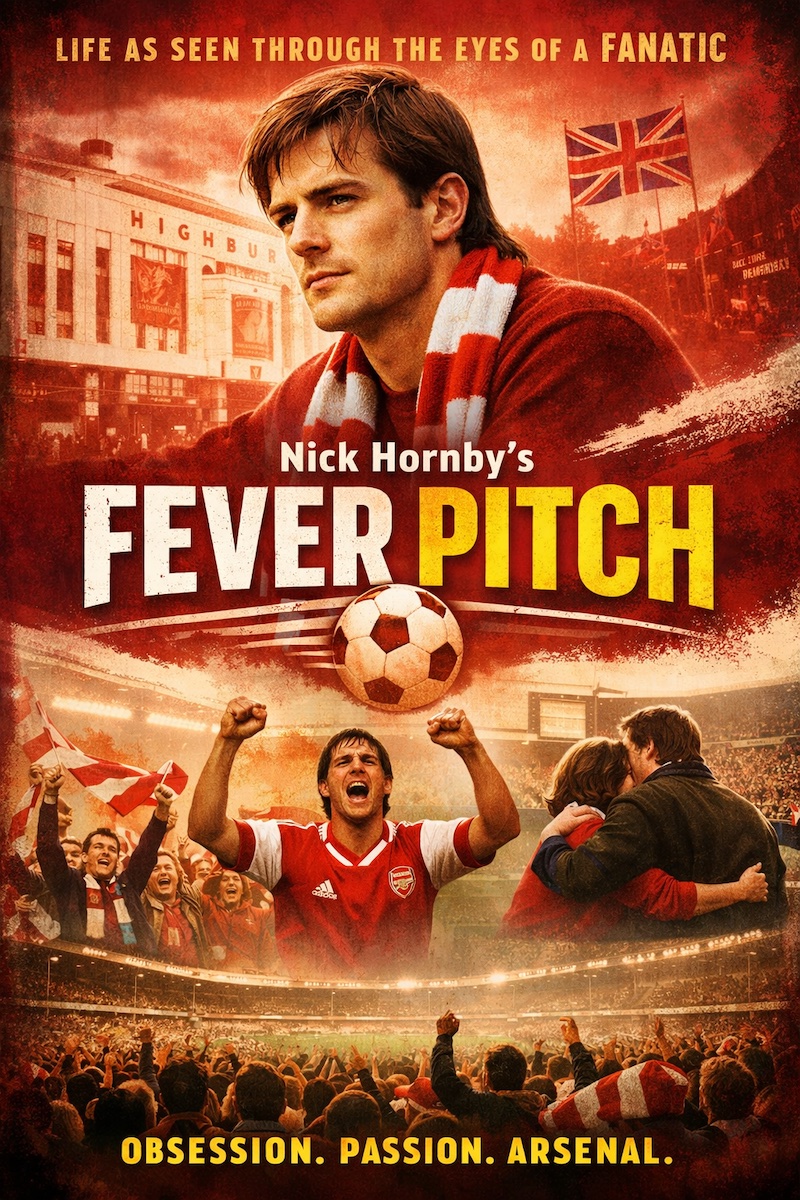
Fever Pitch by Nick Hornby is a memoir about football, obsession, and identity, told through the lens of Hornby’s lifelong support of Arsenal Football Club. Rather than being a traditional sports book, it uses football as a way to examine childhood, adulthood, relationships, masculinity, and emotional dependency.
The book is structured chronologically, with each chapter anchored to a particular Arsenal match. These matches serve as emotional milestones, mapping Hornby’s life from childhood in the 1960s through early adulthood in the late 1980s.
As a boy, Hornby becomes an Arsenal supporter largely through his father, discovering early that football fandom is not a rational choice but a permanent attachment. He learns that loyalty is involuntary, emotional, and often painful. Victories bring fleeting joy, while defeats linger and shape mood, memory, and self-worth.
During his teenage years, Arsenal becomes a substitute for family and stability following his parents’ divorce. The club provides ritual, community, and belonging, even as it demands total emotional investment. Hornby explores how football crowds create collective identity, how stadiums function as sacred spaces, and how fans rely on one another to generate atmosphere and meaning.
As he grows older, Hornby begins to question his obsession. He examines how football interferes with romantic relationships, friendships, and emotional maturity. He reflects on the psychology of fandom—how supporters endure boredom, frustration, and disappointment willingly, and how the quality of football often matters less than the act of consuming it.
The book also addresses darker aspects of football culture in England during the 1970s and 1980s, including violence, hooliganism, unsafe stadiums, and institutional neglect by clubs and authorities. Hornby contrasts English football’s resistance to change with developments elsewhere in Europe.
In the later chapters, Hornby reaches a kind of reconciliation. He realizes that while Arsenal will always be part of him, the club’s successes and failures are not the same as his own. He learns to separate his identity from the team’s results, without ever fully giving up the emotional bond.
Ultimately, Fever Pitch is about how passion shapes a life. Football is not presented as an escape or entertainment, but as an alternative version of reality—one that offers belonging, meaning, and emotional truth, even at great personal cost.
Page 12
As far as I could tell, nobody seemed to enjoy, in the way that I understood the word, anything that happened during the entire afternoon. Within minutes of the kickoff, there was real anger. You're a disgrace, Gold. He's a disgrace. A hundred crud a week? A hundred crud a week? They should give that to me for watching you.
Page 14
Arsenal's best-known player was probably Ian Urie, famous only for being hilariously useless and for his contributions to the television series Quizball.
Page 16
I had been forced to go to bed before the result came through. The tie was played on a Wednesday night, and my mother wrote the score down on a piece of paper and attached it to my bookcase ready for me to look in the morning. I looked long and hard. I felt betrayed by what she had written. If she loved me, then surely she could have come up with a better result than this.
Page 22
By the early 70s, I had become an Englishman. That is to say, I hated England just as much as half my compatriots seemed to do. I was alienated by the manager's ignorance, prejudice, and fear, positive that my own choices would destroy any team in the world, and I had deep antihipay towards players from Tottenham, Leeds, Liverpool, and Manchester United.
Page 27
As Arsenal Huffton puffed their way towards a 1-0 win and nilled draws, I wriggled with embarrassment, waiting for Dad to articulate his dissatisfaction. I had discovered after the Swindon game that loyalty, at least in football terms, was not a moral choice like bravery or kindness. It was more like a wart or a hump, something you were stuck with. Marriages are nowhere near as rigid.
Page 36
1971 was Arsenal's Annus Mirabilis. They won the league, championship, and the FA Cup in the same season, the famous double that only three teams this century have managed. In fact, they won the trophies in the same week. On Monday night, they won the championship at Tottenham, and on Saturday, the Cup against Liverpool at Wembley. I wasn't there. I wasn't at Tottenham because I still wasn't allowed to go to a midweek match on a school night on my own. I wasn't at Wembley because Dad didn't come through with the ticket, despite promises to the contrary, and yes, I'm still bitter 20 years on.
Page 38
Chelsea, we're flamboyant, unpredictable, and it has to be said, not the most reliable of teams. My father had a taste for pink shirts and theatrical ties, and stern moralist that I was, I think I felt that he could have done with a little more consistency.
Page 47
It was difficult to watch football safely at away grounds. Standing in the section reserved for visitors didn't ensure any protection. In fact, it merely informed the opposition of your identity.
Page 48
Charlie George differed slightly from the rebel norm on two accounts. Firstly, he had actually spent his early teenage years on the terraces of the club for which he later played, and though this is not unusual in itself, plenty of Liverpool and Newcastle players supported these clubs when they were young. George is one of the few genius misfits to have jumped straight over the perimeter fence into a club's shirt and shorts.
Page 56
My cup final ticket had come directly from the club, rather than via touts and my dad, and I was ludicrously proud of it. Even more eccentric was the joy I took in the compliment slip that came with it, which I stored away for years afterwards. Cup tickets were allocated on the basis of the numbered vouchers that appeared on the back of the program. If you had all the programs, as I did, you were more or less assured of a ticket.
Page 62
The man shook his head. No, dead. I was just walking behind him and he keeled over. He looked dead. He was gray and, as far as we were concerned, unanimously motionless. We were impressed. Frog sensed a story that would interest not only the fourth year, but much of the fifth year as well. Who done him? Scousers? At this point, the man lost his patience. No, he had a heart attack. You little prats. Now fuck off.
Page 65
I had plotted my debut with great care. For much of that season, I'd spent more time staring at the alarming lump of noisy humanity to my right than straight ahead at the pitch. I was trying to work out exactly where I would make four and what parts I should avoid. The Ipswich game looked like my ideal opportunity. Ipswich fans were hardly likely to attempt to take the North Bank, and the crowd wouldn't be much more than 30,000 and a half the capacity. I was ready to leave the schoolboys behind.
Page 68
Part of the pleasure to be had in large football stadia is a mixture of the vicarious and the parasitical, because unless one stands in the North Bank or the KOP or the Stretford End, then one is relying on others to provide the atmosphere, and the atmosphere is one of the crucial ingredients of the football experience.
Page 78
My mother has no brothers and sisters. All my relatives come from my father's side, and my parents' divorce isolated my mother and sister and me from the leafier branch of the family. Partly through our own choice, partly through our geographical distance, it has been suggested to me that Arsenal substituted for an extended family during my teens, and though this is the kind of excuse I would like to make for myself, it is difficult even for me to explain how football could have performed the same function in my life as boisterous cousins, kindly aunts, and avuncular uncles.
Page 85
I sweated in the August sunshine and I cursed, and I felt the old screaming frustration that I had been happily living without. Like alcoholics who feel strong enough to pour themselves just one small one, I had made a fatal mistake.
Page 87
The SuperMac myth is a confidence trick that the club plays on itself, and we are happy to indulge it.
Page 88
Football famously is the people's game, and as much as prey to all sorts of people who aren't, as it were, the people. Some like it because they are sentimental socialists, some because they went to public school and regret doing so, some because their occupation, writer or broadcaster or advertiser executive, has removed them far from where they feel they belong, or where they have come from, and football seems to them a quick and painless way to get back there. Thank you.
Page 89
I went to Highbury from Maidenhead in the holidays and traveled from Cambridge for the big games, but I couldn't afford to do it very often, which is how I fell in love all over again with Cambridge United. I hadn't intended to. Us were only supposed to scratch the Saturday afternoon itch, but they ended up competing for attention in a way that nobody else had managed before.
Page 95
I have met women who love football and go to watch a number of games a season, but I have not yet met one who would make that Wednesday night trip to Plymouth.
Page 98
It is a truth university to acknowledge that ticket distribution for cup finals is a farce. The two clubs involved, as all supporters know, get less than half the tickets, which means that 30 or 40,000 people with no direct interest in the game get the other half.
Page 101
Chris Roberts bought a Sugar Mouse from Jack Reynolds and bit its head off, dropped it in the New Market Road before he could get started on the body, and it got run over by a car. In that afternoon, Cambridge United, who had hitherto been finding life difficult in the Second Division, had beaten Orient at 3-1, and a ritual was born.
Page 105
Manchester United were a proper team. Not a roll over and die, only here for the beer shower like, well, like Ipswich, say, or Swindon. Manchester United were the kind of team who might, well, unsportingly ignore general election deals simply by scoring loads of goals and thrashing us.
Page 108
A silent slash in the middle of them, the only concession to the calendar used everywhere in the Western world. We get drunk on New Year's Eve just as everyone else does, but really it is after the Cup Final in May that our mental clock is wound back and we indulge in all the vows and regrets and renewals that ordinary people allow themselves at the end of the conventional year.
Page 110
I'm not a good radio listener, but then very few fans are. The crowds are so much quicker than the commentators. The roars and the groans precede the description of the action by several seconds, and my inability to see the pitch makes me much more nervous than I would be if I were at the game or watching on TV.
Page 112
I think that I can speak for all of us when I say that we used to like passing, and that we felt that, on a whole, it was a good thing. It was nice to watch football's prettiest accessory. A good player could pass to a teammate we hadn't seen or find an angle we wouldn't have thought of, so there was a pleasing geometry to it. But managers seemed to feel that it was a lot of trouble, and therefore stopped bothering to reduce any players who could do it.
Page 113
All the best footballer plays have some kind of wit about them. Lineker's anticipation, Shilton's positioning, Beckenbauer's understanding are products of their brain rather than functions of simple athleticism, yet it is the classical midfielder who has cerebral attributes receive the most attention, particularly from the sports writers on the quality papers and from the middle-class football fans.
Page 116
Every Arsenal fan, the youngest and the oldest, is aware that no one likes us, and every day we hear that dislike reiterated. The average media-attuned football fan, someone who reads a sports page most days, watches TV whether it's on, reads a fanzine or a football magazine, will come across a sliding reference to Arsenal maybe two or three times a week, about as often as he or she will hear a Lennon and McCartney song, I would guess.
Page 116
We never did replace him satisfactorily, but we found different people with different qualities. It took me a long time to realize that this is a good way of coping with loss as any.
Page 117
We're boring and lucky and dirty and petulant and rich and mean, and have been, as far as I can tell since the 1930s. That was when the greatest football manager of all time, Herbert Chapman, introduced an extra defender and changed the way football was played, thus founding Arsenal's reputation for negative, unattractive football. Yet successful Arsenal teams, notably the double team in 1971, used an intimidatingly competent defense as a springboard for success.
Page 122
In this fantasy, my son, as rapt, intense, and unhappy as I was when I first supported Arsenal, is a Spurs fan, and we could not get tickets for Wembley. We are watching the game at home on TV. In the last minute in the Old War Horse, Kevin Campbell scores the winner, and I explode into a frenzy of joy, leaping around the sitting room, punching the air, jeering at, jostling, tussling the head of my own traumatized child. I fear that I am capable of this, and therefore the mature, self-knowing thing to do would be to see the vasectomist this afternoon.
Page 125
Nobody, not even somebody like me, would have been able to remember the game had it not been for the post-match press conference, when Alan Durbin became angered by the hostility of the journalists towards his team and his tactics. If you want entertainment, he snarled, go and watch clowns.
Page 127
For my own part, I am an Arsenal fan first and a football fan second. And yes, again, I know all the jokes. I will never be able to enjoy the Gaza goal, and there are countless other similar moments, but I know what entertaining football is, and I've loved the relatively few occasions when Arsenal have managed to produce it. And when other teams who are not in competition with Arsenal in any way play with flair and berve, then I can appreciate that too.
Page 131
... was completely consumed by all things Arsenal, and I pounced. But when I had my confession, there was no meeting of minds or fond slow-motion embrace. Instead, I received a look of utter contempt. You? He said. You? What do you know about it? For a moment, I saw myself through his eyes, a pillock in my tie with an irritating smile, desperately trying to worm my way into places I had no right to be and understood. But then something else - a rage born out of 13 years at Highbury Hill, probably an unwillingness to abandon one of the most important elements of my self-identity to chalky-tweedy facelessness - took over, and I went mad.
Page 133
In my experience, there was more violence in the 70s. That is to say, there was fighting more and less every week.... It was less predictable and much nastier. Police confiscated knives and machetes and other weapons I did not recognize, things with spikes coming out of them, and there was that famous photograph of a fan with a dart sticking from his nose.
Page 140
I feel that if I could just score once in the North Bank and run behind the gold of the fans, then I could at least leave behind all childish things.
Page 142
In the end, I learned from this period more than any other in my footballing history that it simply doesn't matter to me how bad things get, that results have nothing to do with anything. And as I have implied before, I would like to be one of those people who treat their local team like their local restaurant and thus withdraw their patronage if they are being served up obnoxious garbage. But unfortunately, and this is one reason why football has got itself into so many messes without having to clear any of them up, there are many fans like me. For us, the consumption is all, the quality of the product is immaterial.
Page 144
Interestingly, I think that he has the same tendency to let his life drift along a little, the same confusions about what he wants to do with it, and I think that, like me, he has allowed Arsenal to fill gaps that should have been occupied by something else. But didn't we all do that?
Page 152
The police were doing things, and the fans were doing things. It was this post-ISIL climate of despair that produced the life-saving When Saturday Comes and all the club fanzines, and the Football Supporters Association, whose Rogan Taylor was such an accomplished and passionate and intelligent spokesman in the weeks after Hillsborough, four years later. But the clubs, I'm afraid to say, did nothing.
Page 156
The girl who had to tolerate my sulk could see that I was not the only one, that there was this whole community who cared about what was happening to their arsenal more than they cared about anything else. The things that I have often tried to explain to people about football, that it's not an escape or a form of entertainment, but a different version of the world, were clear for her to see. I felt vindicated somehow.
Page 161
The most intense of all football relationships is, of course, between fan and club, but the relationship between fan and manager can be just as powerful. Players can rarely alter the whole tone of the lives like managers can, and each time a new is appointed, it is possible to dream bigger dreams than the previous one ever allowed.
Page 163
She craned her neck and watched what she could see, and after the game we went to the pub and she said she'd like to come again. This is what women always say, and it usually means that they would like to come again in another life, and not even in the next life, but the one after that.
Page 165
They don't win things every season, you know. I kept telling her, with all the pointless and bilious envy of a parent whose Mars Bar's munching child has never experienced the deprivations of wartime rationing.
Page 174
In the lift they gave me enabled me to part company from them. In some ways, though, I am still one of Arsenal's most devoted fans, and though I still go to every home game and feel the same tensions and elations and gloom that I have always felt, I now understand them to have entirely separate identity whose success and failures had no relationship of my own.
Page 179
The players are merely our representatives chosen by the manager rather than elected by us, but are representatives nonetheless, and sometimes if you look hard you can see the little poles that join them together and the bundles at the side that enables us to move them. I am a part of the club just as the club is a part of me, and I say this fully aware that the club exploits me, disregards my views, and treats me shoddily on occasions, so my feelings of organic connection is not built on a modal-headed and central misunderstanding of how professional football works.
Page 184
Neil Kaas facts.
Page 186
I know this happens. On the night of 26th of May 1989, I came back to my flat after cruising deep into the night to find 14 or 15 phone messages from friends all over Britain and Europe, some of whom I hadn't spoken to for months, often on the day after an arsenal calamity or triumph. I received phone calls from friends, even non-footballing friends, who had been reminded to contact me by newspaper or a chance idle glance at a sports roundup at the end of the news bulletin.
Page 192
There is nowhere else you can be in the entire country that will make you feel as though you are at the heart of things. Because whichever nightclub you go to or play or film or whichever concert you see or restaurant you eat at, life will have been going on elsewhere in your absence, as it always does. But when I'm at Highbury for games like these, I feel that the rest of the world has stopped and is gathered outside the gates, waiting to hear the final score.
Page 195
So among crowds of 25,000, you'll find a few hundred troublemakers. When you're getting crowds of 5,000 or 6,000, the same few hundred, will still be turning up, and suddenly the tiny minority have become much more significant, and the clubs are landed with a bad reputation.
Page 201
Gus must have known he was good, just as any pop band who has ever played the Marquee know they are destined for Madison Square Garden. In an NME front cover, just as any writer who has sent off a completed manuscript to Faber and Faber knows that he is two years away from the Booker.
You trust the feeling with your life. You feel the strength, the determination it gives you coursing through your veins like heroin. It doesn't mean anything at all.
Page 206
I have begun to suspect that my relationship is with Highbury rather than with the team. If the match had taken place at the Valley or Sellers Park or Upton Park, none of them inaccessible, you might have thought to a man as obsessive as this one, then I wouldn't have gone. So what's this all about? Why am I hellbent on seeing a match involving Arsenal one part of London but not the other?
Page 211
This was the time to build new stadia out of the town. With parking facilities improved safety provisions, the rest of Europe did. And as a consequence, the grounds in Italy, Spain, Portugal, and France are bigger, better, and safer. But typically in a country whose infrastructure is finally beginning to fall apart, we didn't bother. Here, tens and thousands of fans walk up narrow winding underground tunnels or double park their cars in tiny quiet local streets while the relevant football authorities seem content to carry on as if nothing is happening.
Page 215
One must look to Europe. The Italians, the Portuguese, and the Spanish have high ticket prices, but they can afford to pay for the best players in Europe and South America. They are also less obsessed with lower league football than we are. They are third and fourth division clubs, but they are semi-professional and do not influence the way the game is structured. The first division takes precedence, and the football climate is all the healthier for it.
Page 216
Britain's football grounds now resemble maximum security prisons, but only the feebleness of the regulations has allowed the clubs to go on pretending that crowd safety is compatible with prison architecture. On the football authorities, for complacency and incompetence, there's nothing like a cartel, and of Britain's surviving cartels, the football's league is one of the smuggest and slackest.
Page 219
After the Wimbledon game I had no rage left, just a numbing disappointment. For the first time I understood that women in soap operas who have been crushed by love affairs before and can't allow themselves to fall for somebody again. I had never before seen all that as a matter of choice, but now I too had felt myself nakedly exposed when I could have remained hard and cynical, I wouldn't allow it to happen again. I had been a fool, I knew that now, just as I knew it would take me years to recover from the terrible disappointment of getting so close and failing.
Page 223
After 21 years, I no longer felt, as I had done during the double year, that if I hadn't been to the games, I had no right to partake in the celebrations. I'd done the work, years and years and years of it, and I belonged.
Page 223
Arsenal aren't a Nottingham Forest or a West Ham or even a Liverpool. A team that inspires affection or admiration in other football fans. We share our pleasures with nobody but ourselves.
Page 233
Why Arsenal behave like this is not a very interesting one. I suspect that the answer is that they behave like this because they are Arsenal, and they understand their allotted role in the football scheme of things. A more interesting question is this. What does it do to the fans? How is your psyche affected when you commit yourself for a lifetime to the team that everybody loves to hate? Are football fans like the dogs that come to resemble their masters?
Page 234
Like my club, I am not equipped with particular thick skin. My oversensitivity to criticism means that I am more likely to pull up the drawbridge and bitterly bemoan my lot than I am to offer a quick handshake and get on with the game. In true Arsenal style, I can dish it out, but I can't take it.
—--
Image Credit:
Generated
Subscribe to get the most recent posts in your inbox!








Almost Informative Guide to Soccer in Chicago
Explore this Almost Informative guide to soccer in Chicago, packed with cultural, shopping, culinary, and media highlights!