in
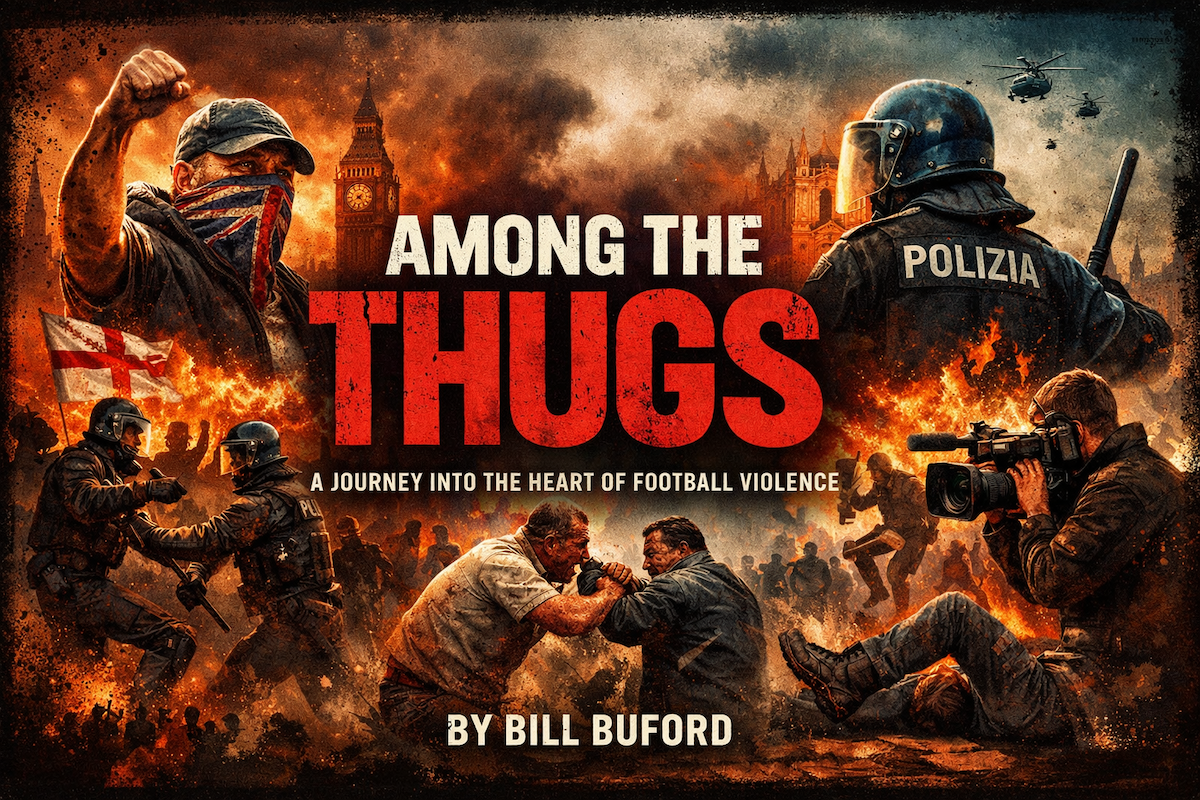
Book Club: Among The Thugs by Bill Buford
Published on: February 6, 2026
By Drew
Thematic Outline: Violence, Identity, and Consciousness in Among the Thugs
I. Violence as Latent Human Capacity
A. Universality of Violent Potential
- “We’ve all got it in us… it just needs a cause.” (p.116)
- Violence is framed not as deviance but as dormant potential energy within ordinary individuals.
- Requires legitimacy, ritual, or context to surface.
B. Violence as Existential Reduction
- “Nothingness in its beauty… nihilistic purity.” (p.193)
- “The moment when consciousness ceases…” (p.205)
- Violence offers psychological singularity — the collapse of cognitive multiplicity into pure immediacy.
C. The Appeal of Animal Intensity
- Violence reduces complexity to survival and presence.
- Functions as relief from modern mental fragmentation (see p.204 on roaming consciousness).
Argument Thread: Violence is not simply social pathology; it is psychologically seductive because it simplifies existence.
II. Structural and Political Interpretations of Violence
A. Violence as Social Protest
- Football as outlet for economic frustration and unemployment.
- “Social rebellion, class rebellion, something.”
B. State Utility and Manufactured Division
- Phil’s argument (p.147): Government benefits from working-class fragmentation.
- Violence distracts from systemic inequities.
C. Deviation vs. Continuity Debate
- p.248: Violence interpreted either as modern decay or timeless human pattern.
- British nostalgia vs. modern sociological determinism.
Argument Thread: Competing frameworks attempt to rationalize violence either as structural grievance or as anthropological constant.
III. Post-Imperial Identity and National Performance
A. Island Mentality and European Alienation
- “Is it because you lost the empire?”
- Identity crisis framed through external observation.
B. War as Clarity and Belonging
- “They wanted a war. They wanted a nation to belong to.”
- Conflict substitutes for ideological coherence.
C. Stylized Masculinity without Substance
- “Bloated code of maleness… exaggerated patriotism.” (p.262)
- National identity reduced to aesthetic and performance.
Argument Thread: Violence becomes compensatory theater for post-imperial dislocation and masculine insecurity.
IV. Crowd Mechanics and Spatial Containment
A. Physics of the Crowd
- “The principle of the shove…”
- Escalation emerges mechanically, not ideologically.
B. Physicality of Spectatorship
- English terraces as inherently bodily and abrasive (p.164).
- Brutality normalized through tradition.
C. Containment and Pressure
- Steel fences and spatial limits (p.199).
- Physical compression mirrors psychological and social compression.
Argument Thread: Violence is emergent — produced by density, ritualized physicality, and environmental pressure.
V. Moral Minimization and Contextual Relativism
A. Reframing Harm
- “I have just been naughty.” (p.90)
- Moral severity shrinks within collective escalation.
B. Diffusion of Responsibility
- p.76: English? Italians? Media?
- Blame becomes structurally dispersed.
C. Normalization through Context
- “In the context of the day…”
- The environment recalibrates ethical thresholds.
Argument Thread: Moral reasoning becomes situational; collective intensity reshapes personal accountability.
VI. Media Representation and Narrative Construction
A. Anticipatory Framing
- Media images reinforce expectations before violence occurs.
B. Snapshot Distortion
- p.282: Crowds represented only in peak frenzy moments.
- Mechanisms preceding violence remain invisible.
C. The Observer’s Authority
- “It is not the crowd… It is the observers of the crowd…” (p.184)
- Public understanding mediated by external narration.
Argument Thread: Violence is co-produced by representation; media anticipation scripts behavior.
VII. Subculture, Ritual, and Apprenticeship
A. Internal Hierarchies
- Division within the firm (p.62).
- Status defined by locality and participation.
B. Ritualized Illegality
- “Being on the jib” as initiation and bonding.
- Risk functions as social glue.
C. Apprenticeship Narrative
- “I had much to learn.”
- Entry into subculture involves gradual normalization of deviance.
Argument Thread: Hooliganism operates as structured subculture with its own systems of knowledge, prestige, and belonging.
VIII. Addiction, Craving, and Sensory Immersion
A. Escalation of Pleasure
- Violence compared to alcohol and tobacco.
- Disgust → enjoyment → dependency.
B. Bodily Craving for the Game
- “Developing a craving for a goal…” (p.167).
- Spectatorship becomes physiological appetite.
C. Dissolution of Self
- “I was ceasing to be me.”
- Identity temporarily suspended within collective immersion.
Argument Thread: The appeal of violence lies not solely in aggression but in altered states of consciousness.
IX. Absurdity, Theater, and Symbolic Conflict
A. Lamppost Incident (p.229)
- Aggression detached from meaningful target.
- National honor invoked for trivial confrontation.
B. Diplomatic Satire (p.268)
- Preemptive apology as national embarrassment.
- Violence as expected performance abroad.
Argument Thread: Violence often operates as ritual theater — symbolic enactment of identity rather than substantive conflict.
Synthesis: Core Analytical Axes
Across these themes, the text converges on five central analytical axes:
- Belonging vs. Alienation
- Multiplicity of Consciousness vs. Singular Intensity
- Structure vs. Agency
- Representation vs. Reality
- Identity as Substance vs. Identity as Performance
Provisional Thesis
Among the Thugs ultimately argues that football violence is not reducible to class grievance, nationalism, or criminality alone. It is a complex convergence of structural pressure, subcultural ritual, existential longing, and representational amplification. Violence becomes both a means of belonging and an escape from the burdens of modern consciousness — a temporary collapse into collective simplicity.
Page 62
"I remember Mick's account of being on the jib. I had much to learn and most of it I would learn the next day on my return to England, but initially I was skeptical. How was it possible that so many people could travel on the jib? From what I understood about travelling on the jib, it meant not only not paying, but actually making money as well."
Page 76
"I remember thinking, if the day becomes more violent, who do you blame? The English, whose behavior on the square could be said to have been so provocative that they deserved whatever they got? The Italians, whose welcome consisted in inflicting injuries upon their visitors? Or can you place some of the blame on these men with their television equipment and their cameras, whose misrepresentative images served only to reinforce what everybody had come to expect?"
Page 90
"He had done something bad, extremely bad, and his face, while acknowledging the badness of it, was actually saying something more complex. It was saying that what he had done wasn't really all that bad. In the context of the day, it wasn't that extreme, was it? What his face expressed, I realized, his eyes seemed to twinkle, was no more than this: I have just been naughty."
Page 116
"The violence, he said, we've all got it in us, it just needs a cause. It needs an acceptable way of coming out, and it doesn't matter what it is. But something, it's almost an excuse, but it's got to come out. Everybody's got it in them."
Page 147
"Phil was disgusted by football violence, or at least he put up a good show of disgust. According to Phil, it was all the government's making. The government had the power to stop the violence, if it wanted. Phil believed, but it didn't. But it hadn't because it was in its interest to keep the violence going. It was in its interest to turn working people against each other. It deflected the working people from having to address the real problems of their lives."
Page 164
"There is no sport in which the act of being a spectator is as constantly physical as watching a game of English football in the terraces. This physicalness is insistent. Any observer not familiar with the game would say that it is outright brutal. In fact, those who do not find it brutal are those so familiar with the traditions of attending an English football match, so certain in the knowledge of what is expected of them, that they are incapable of seeing how deviant their behavior is, even in the most ordinary things."
Page 167
"As the match progressed, I found that I was developing a craving for a goal. As its promise and failures continued to be expressed through the bodies of the people pressed against me, I had a feeling akin to an appetite, increasingly more intense, of anticipation, waiting for, hoping for, wanting one of those shots to get past the Millwall goalkeeper. The business of watching the match had started to exclude other thoughts. It was involving so many aspects of my person: what I saw, smelled, said, sang, moaned; what I had was feelings up and down my body, that I was becoming a different person from the one who had entered the ground. I was ceasing to be me. There wasn't one moment when I stopped noticing myself; there was only a realization that for a period of time I hadn't been."
Page 184
"It is not the crowd. The crowd does not tell us its histories. It is the observers of the crowd, listening to each other as much as to the shouting outside their windows."
Page 193
"Being in a crowd, and greater still, being in a crowd in an act of violence, nothingness is what you find there. Nothingness in its beauty, its simplicity, its nihilistic purity."
Page 199
"They were boxed in during the match, literally a box, its sides made of the heavy steel fences of the enclosed terraces. Throughout, the containment has been absolute; at every moment, there have been limits."
Page 204
"The human mind is never at rest in the present. It is always roving, recalling, remembering, selecting, adding, forgetting. Sitting in the room as I write, my mind is accompanying so many different activities at once. It encompasses this sentence as I write it. It has already encompassed the next one. It has completed this book and it has at the same time not completed it. It has never completed it. It accommodates the state of the kitchen, the sound of the birds outside, the quality of light, the items that I must address later in the day. Human consciousness exists on far more levels than consciousness itself could represent. This is our reality, our humanness, the thousand million stimulants of the moment, the indiscriminate mass of motion, the mind is constantly engaging, disengaging, abandoning, retrieving."
Page 205
"I am attracted to the moment when consciousness ceases, the moment of survival, of animal intensity, of violence, when there is no multiplicity, no potential for different levels of thought. There is only one, the present and its absoluteness."
Page 229
"Finally, after an interminable amount of friendliness, someone's responded aggressively to one of Grimsby's provocations, and with the nation's reputation at stake, fists were momentarily flying. I am not certain that anybody did respond; it might have been a lamppost. It was possible that Grimsby had reached the point where he had started punching a small functional article of urban architecture. Grimsby was then arrested."
Page 248
"There is a tendency in any one analysis of violence to look upon it in one of two ways: as a deviation from the past or as a continuation from it. Either the violence of today is symptomatic of the rot of our times, the urban blight, the loss of our faith, the disintegration of our families, the want of discipline in our homes, or the violence of today is fundamentally no different from what it was yesterday. There is always violence in one form or another. The first view, the more obviously sentimental one with its implicit nostalgia for a golden age, seems to be especially prevalent in Britain, if only because the self-image of the British as civilized and law-abiding is still remarkably so deeply rooted in the culture. It is the modern and modernist view that sees violence as communication, that it is a manifestation of inherently unchanging patterns, sociological, biological, psychological, something in any event beyond our controlling."
Page 262
"London lads have simply become more exaggerated, ornate versions of an ancient style, more extreme because now without substance, but it is not only a style, nothing substantive is there. There is nothing to belong to, although it is still possible, I suppose, to belong to a phrase, the working class, a piece of the language that serves to reinforce the certain social custom and in a way of talking and that obscure the fact that the only thing hiding behind it is a highly mannered suburban society stripped of culture and sophistication and living only for its affectionateness, a bloated code of maleness, an exaggerated, embarrassing patriotism, a violent nationalism, an array of bankrupt antisocial habits."
Page 268
"It was not, it was without precedent. Another country's cabinet minister does not visit a nation about to hold a sporting event with this kind of message. If you invite a friend and his family over for lunch, and then after accepting your invitation, he mentions in passing that his children were prone to do story parts of your house. They'll rip up your lawn, pull out your shrubs, urinate on your bathroom walls, get sick on your carpets, break most of your windows, and then grind fish and chips into your new sofa. You would be inclined to withdraw the invitation, or at least suggest that perhaps the kids could be left behind this time."
Page 282
"A violent crowd is represented rarely by its members, but by its victims, the witnesses who become fully aware of its existence only when they are threatened by it. These are snapshot moments, inevitably the very moments when a crowd is at its most frenzied, its leaders at their most prominent, the conduct of both of their most ostensibly irrational. But so much of the nature of the crowd and its mechanisms of behaving is, as I have also tried to show, determined before these snapshot moments, before a crowd is dangerous or conspicuous enough for people outside to take notice. These fools, despised at home, ridiculed in the press, incapable of being contained by any act of impulsive legislation that the government had devised, wanted an England to defend. They didn't want Europe. They didn't understand Europe and didn't want to. They wanted a war. They wanted a nation to belong to and to fight for, even if the fight was this absurd piece of street theater with the local Italian police."
Image Credit:
Generated
Subscribe to get the most recent posts in your inbox!




Almost Informative Guide to Soccer in Chicago
Explore this Almost Informative guide to soccer in Chicago, packed with cultural, shopping, culinary, and media highlights!